Comparisons
RedTrack Alternatives for Affiliate Media Buyers
Build a shortlist around page ownership, provider feedback, automation, hosting responsibility, and event costs. Four options to consider without a fabricated ranking.

Choose a RedTrack alternative around the workflow you want to change. Keep the conversion evidence you already trust in your migration plan. Consider Tracked for hosted-page work and ClickFlare for its documented cloud tracking and conversion integrations. Consider Voluum for documented routing and automation, or Binom for hosting control and its managed cloud option.
This is a Tracked-authored selection guide, not an independent tested review. We reviewed vendor documentation and current Tracked source code on October 6, 2026. We did not run competitor accounts, benchmark redirect speed, or collect customer results. The order is not a ranking; documented capabilities are not independently verified outcomes.
This guide compares several options. The direct Tracked vs. RedTrack comparison covers those two products in more detail. Use the affiliate software buying checklist to define requirements before comparing subscriptions.
First decide what you want to change
If the problem is an unexplained conversion gap, changing trackers may carry the same broken sub-ID or callback into a new account. Identify the missing evidence first. If the problem is page publishing, provider feedback, event costs, or infrastructure ownership, make that the selection criterion.
| Your requirement | Candidate to investigate | Decision boundary |
|---|---|---|
| Host imported page files and make the next edit beside campaign reports | Tracked | Invite-gated early access; universal CAPI and automatic winner selection are in development |
| Keep cloud tracking and evaluate documented conversion integrations | ClickFlare | Confirm the exact provider flow, event counting, account limits, and external page setup |
| Evaluate traffic distribution and ad-management automation | Voluum | Official features describe automation; verify plan inclusion and provider permissions. Current price extraction was inconclusive |
| Own the tracker server, or compare it with a managed hosting option | Binom | Self-hosting adds server responsibilities. Cloud is also offered; confirm version-specific integrations and billing cadence |
| Keep working feedback and automations with minimal migration disruption | RedTrack itself | Compare the cost of repairing your existing flow with the cutover work, not only a competing base price |
A page editor is not an exclusive Tracked feature across this shortlist. Binom's official page also advertises integrated landing-page storage and editing. Compare the actual editor and deployment workflow you need rather than claiming that no competitor can host a page.
Use affiliate plans as the baseline
RedTrack's pricing page separates Affiliates & lead gen from Ecom & DTC. This article uses affiliate plans. Revenue-based ecommerce tiers answer a different buying question.
On October 6, 2026, RedTrack listed Builder at $79/month billed monthly for 2 million events; Solo at $169 for 5 million; Team at $399 for 20 million; and Enterprise at $999 for 75 million. Annual-billing monthly equivalents were $69, $141, $333, and $833 respectively—not month-to-month prices.
Builder/Solo include one user, Team five, and Enterprise fifteen. Spend-sync cadence is every six hours, hourly, every thirty minutes, and every thirty minutes respectively. Extra Team/Enterprise users cost $29/month or $290/year. Faster sync and setup assistance can add cost.
The pricing tooltip calls an event a click or conversion. The campaign guide also counts landing-page clicks, click forwarding, and other tracked events. Confirm your flow's billable events rather than equating the allowance with ad clicks. Listed overages are $0.04 per 1,000 on Builder/Solo, $0.035 on Team, and $0.025 on Enterprise; pricing says tracking continues above the allowance.
Compare prices without inventing unknown terms
All figures below are USD. These are source-backed starting points, not quotes or equivalent feature bundles.
| Option | True monthly billing or current displayed catalog | Separate annual terms | Capacity and unresolved terms |
|---|---|---|---|
| Tracked | Displayed placeholder prices, not confirmed account terms: Free $0; Solo $79/month; Team $249/month; Agency $549/month; Enterprise from $999/month, custom quote | No annual figure asserted here | Free lists 1,000 events/day; paid tiers list 2M/10M/40M/100M events/month. Catalog prices are placeholders pending finalized live Stripe Prices; limits are display-only. Confirm checkout and overage handling (pricing) |
| ClickFlare | Starter $89/month; Pro $219/month on separate monthly cards | Starter $69/month equivalent; Pro $169/month equivalent in yearly cards with yearly savings | Starter 1M monthly events; Pro 5M. Starter has 3 domains and no additional users; Pro 6 domains and 2 additional users. Counted activity and overages are described below (pricing) |
| Voluum | Unconfirmed | Unconfirmed | Official pricing extraction exposed no usable plan figures or allowances; check the current selector and contract rather than an old price (pricing) |
| Binom | Billing cadence unconfirmed; not stated as a monthly rate here | Unconfirmed | Price page exposes $149/$104 for v2 and $299 for Cloud, without clear cadence in extracted text. Confirm the applicable offer, version, server costs, and capacity (pricing) |
ClickFlare's pricing FAQ defines events as tracked activity including visits, clicks, conversions, and postbacks. Starter overages are $0.04 per 1,000 events; Pro overages are $0.035 per 1,000. Pricing says tracking continues above the allowance, so exceeding it does not automatically require a tier upgrade.
Do not calculate savings from this table. A visit, offer click, conversion, or forwarding event may consume different allowances across products. Add page hosting you would keep, server operations, extra domains/seats, faster sync, and required support. Tracked's hosted files also use plan storage.
Tracked: keep the page work beside the campaign evidence
Consider Tracked when you own HTML or ZIP landing pages and frequently change them after reviewing a funnel. Current source supports imported-page hosting, visual editing, configured page/offer weights, rules, inbound conversion callbacks, reports, and event journeys.
The practical benefit is locating the page asset beside the campaign path that produced the evidence. It is not a measured conversion improvement or a claim that switching removes setup.
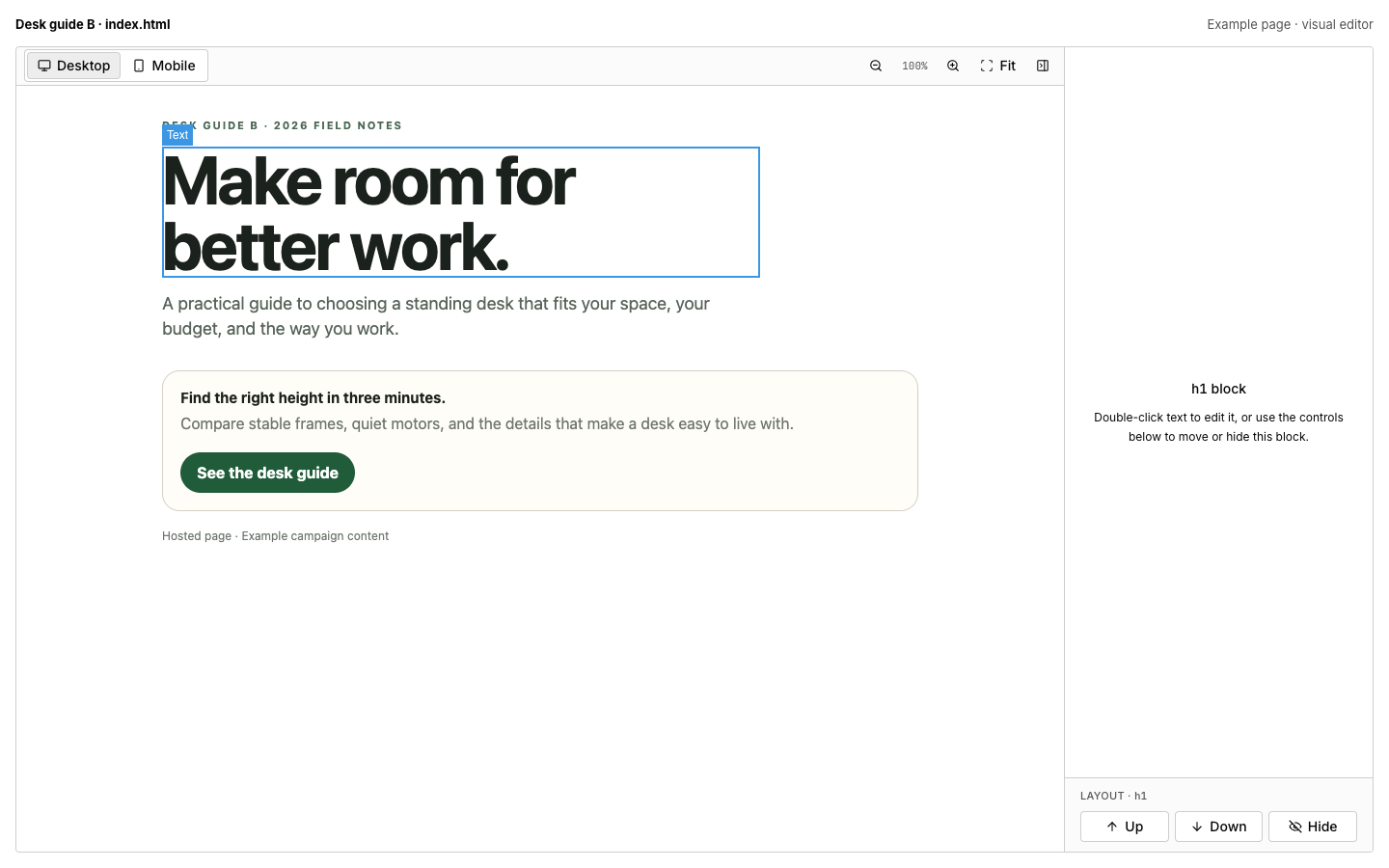
Example editor content; no customer-performance result is implied.
Check account terms first. Signup requires an invite or approved access. Display-only Solo allowances list one seat, five domains, and 5 GB storage; Team lists five seats, unlimited domains, and 25 GB storage. Public events include tracking activity such as visits, offer clicks, and conversions. Confirm current checkout terms and applicable allowances before sending paid volume.
Illustrative campaign evidence to ask for
This example is grounded in current Tracked routing and callback source, not a new executed test. Imagine two hosted page variants, equal configured weights, and one offer. The dispatcher makes a weighted selection; the buyer—not an automatic winner algorithm—sets the split.
The offer click must pass its Tracked click reference into the network's sub-ID. An approved sale can return an untyped /postback callback carrying click_id, payout, and currency. Inspect the matched click, conversion, and report before choosing a page edit. Current code treats explicitly typed callbacks as secondary funnel signals with zero payout; event naming needs deliberate mapping.
Ask every shortlisted vendor to show the equivalent evidence chain using your network. An inbound callback is not proof that an ad platform received or attributed a conversion. This article does not report that any vendor passed such an account-level evaluation.
ClickFlare: evaluate its provider workflow, not just its plan headline
ClickFlare's pricing page presents cloud tracking with CAPI integration allowances, ad accounts, workspaces, custom SSL domains, and stats API access. Starter lists ten ad accounts per platform and ten CAPI integrations; Pro lists fifty of each. That is a useful shortlist candidate when provider connections and team configuration drive the decision.
Those allowances are vendor descriptions, not proof that your network event reaches your ad account correctly. Confirm event mapping, permitted matching data, spend-sync behavior, retry handling, and provider acceptance for the channel you use. Check whether the chosen plan includes write API operations and report sharing you need; do not infer inclusion from nearby feature labels alone.
The yearly cards pair $69/$169 equivalents with $89/$219 regular figures and yearly savings. Separate monthly cards list $89/$219. Use the billing selector deliberately rather than treating the cheapest scraped figure as monthly billing. For the page-workflow comparison, see Tracked vs. ClickFlare.
Voluum: investigate routing and automation requirements
Voluum's official features describe redirect and direct-script tracking, cost synchronization, reporting, traffic distribution, and automation. Consider it when those operations are the reason for leaving RedTrack rather than page editing alone.
Separate the tracking path from the ad-platform management path. Ask which automation actions your account can run, what data drives a routing change, and which permissions or plan are required. Vendor feature descriptions do not establish measured results or inclusion in every subscription.
We could not establish current prices, allowances, overages, or billing cadence from the official pricing extraction. Those cells remain unconfirmed. Review Voluum's current pricing and the direct Tracked comparison before deciding.
Binom: choose the hosting responsibility as well as the tracker
Binom's official product page describes self-hosted and cloud options, paths/rules/rotations, postbacks, reporting, team permissions, and integrated landing-page storage/editing. That makes it relevant to buyers who want control over the tracker server or a hosted alternative from the same vendor.
Self-hosting requires a server budget and ownership of availability, backups, upgrades, and capacity planning. Binom says its cloud plans include the server and monitoring. Its pricing page lists different processing capacities for v2 and Cloud; a no-per-event license claim does not make server throughput unlimited.
The product FAQ distinguishes integration availability between versions. Confirm the exact version and required Facebook/Google or other provider flow rather than assuming identical coverage. Current extracted price text did not resolve billing cadence or the applicable $149/$104 offer, so we do not label those figures monthly subscriptions. See Tracked vs. Binom for the narrower comparison.
Where Tracked is today
Tracked's hosted-page, configured-routing, callback, and report workflow is supported in current source. Universal CAPI, automatic winner selection, and cross-device attribution are in development. Weighted routing is buyer-configured; anonymous same-device continuity is not cross-device identity matching.
Google Ads click-conversion uploads require account/action mapping, a captured Google click ID, and applicable consent. Configured Taboola/NewsBreak postbacks also need their own click IDs and event mappings. These are provider-specific paths; spend sync differs by provider. Meta can connect a dataset and send a test event or a caller-supplied event payload, but that is not automatic affiliate-postback forwarding. Read the Meta delivery limits before relying on production feedback.
Do not assume a competitor lacks a feature because we did not find documentation for it. Conversely, documented integration lists do not prove your account's complete flow. Check inbound network evidence and outbound provider response separately.
Make the shortlist safe to act on
Pick two candidates around your main constraint, then map one representative funnel. Include page/script ownership, offer sub-IDs, event names, payout rules, duplicate handling, costs, team permissions, and outbound feedback.
Keep old RedTrack callbacks available for late conversions during an agreed transition window. Old click IDs do not become the new tracker's IDs. Plan a rollback and prevent duplicate delivery to ad platforms. Do not assume historical reports or automation rules import unchanged. These are recommended buyer checks, not checks performed for this guide.
Use the RedTrack migration checklist when Tracked makes your shortlist. If the only issue is a missing callback, start with postback troubleshooting before migrating.
Frequently asked questions
What is the best RedTrack alternative for affiliates?
There is no universal winner in this documentation review. Choose candidates around hosted-page work, provider feedback, automation, or hosting control. A required integration or billing constraint can change your shortlist.
Should I use RedTrack ecommerce prices for an affiliate comparison?
No. RedTrack separates affiliate/lead-gen event plans from ecommerce/DTC revenue-based plans. Compare the branch that matches your campaign ownership and conversion source.
Is a cheaper base plan a cheaper campaign?
Not necessarily. Compare event definitions, allowances, overages, support, domains, seats, provider setup, and hosting costs. Current Voluum prices and Binom billing cadence remain unconfirmed here.
Can I move affiliate callbacks without changing the click ID?
Do not assume so. Preserve each tracker's original click-ID path for conversions belonging to its traffic. Rebuild the new offer and callback mappings and plan for late conversions before cutover.
Research sources and next step
First-party sources checked October 6, 2026: RedTrack pricing, affiliate setup, lander setup, and campaign guide; ClickFlare pricing; Voluum features and pricing; Binom product and pricing. Tracked claims were checked against current plan/pricing, signup, routing, callback, and Meta-route source. This is documentation and source-code research, not a tested independent review.
Start free — early access. Use your invite or request access. Bring one page and offer, confirm plan terms, and map your required provider feedback before moving production traffic.