Comparisons
Tracked vs. RedTrack for affiliate media buyers
Choose between Tracked's hosted-page workflow and RedTrack's documented affiliate tracking, provider feedback, and automation. Check plan terms and setup boundaries first.

Choose Tracked when you want to host and edit affiliate pages beside campaign routing and conversion evidence. Consider RedTrack when its documented provider feedback and automation match your requirements. Neither choice removes the work of passing click IDs, mapping network events, and checking costs.
This is a Tracked-authored comparison, not an independent tested review. We read current Tracked source code and first-party RedTrack documentation on October 6, 2026. No new campaign test, speed benchmark, or customer-results study was performed. RedTrack claims below describe its documentation, not behavior we independently verified in an account.
For a wider shortlist, read RedTrack alternatives. For the buying checklist, start with affiliate tracking software for media buyers.
Compare the full affiliate campaign, not just the page editor
| Buyer requirement | Tracked today | RedTrack's documented affiliate workflow |
|---|---|---|
| Own the landing-page files | Import HTML or ZIP pages and serve them on campaign domains | Add a lander URL; install scripts and change CTA links in page code (lander guide) |
| Make the next page edit | Visual editor and page files in the same workspace as campaign reports | The guide directs you to your landing-page editor; this establishes an external-page workflow, not that RedTrack lacks every hosting or editing option |
| Route pages and offers | Buyer-configured weights and conditional rules; no automatic winner selection today | Weighted landers, offers, multi-step funnels, templates, filters, and a smart-distribution setup (campaign guide) |
| Receive affiliate conversions | Inbound callback matches the original Tracked click; event and payout mapping matter | Offer-source templates or custom setup pass the click ID out and return it by postback; conversion types and duplicate modes need configuration (affiliate setup) |
| Return conversions to ads | Configured Google Ads click-conversion uploads, Taboola and NewsBreak postbacks. Meta supplied-event sending is not automatic callback forwarding | Campaign docs distinguish CAPI-integrated sources from configured S2S postbacks; credentials, event conditions, and source parameters still need setup |
| Understand spend and profit | Reports and event journeys; native spend sync varies by provider. Page profit uses allocated campaign spend | Pricing advertises ad-level API spend matching; sync cadence depends on the plan (pricing) |
| Give the team access | Display-only catalog allowances: 1 Solo seat, 5 Team seats, 15 Agency seats; confirm account terms | Affiliate plans list 1 Builder/Solo user, 5 Team users, 15 Enterprise users; extra Team/Enterprise seats cost $29/month or $290/year |
RedTrack's affiliate instructions support both redirect and no-redirect setups. They require the LP click URL on the CTA and the appropriate page script. Do not assume changing a tracker makes a traffic source's destination or tracking policies irrelevant.
RedTrack affiliate prices are not ecommerce prices
The current pricing page separates Affiliates & lead gen from Ecom & DTC. The figures below are the affiliate plans, in USD, checked October 6, 2026. Revenue-based ecommerce tiers are not substitutes for an affiliate event allowance.
| Affiliate plan | Billed monthly | Annual-billing monthly equivalent | Events/month | Users | Tracking domains | Included spend-sync cadence |
|---|---|---|---|---|---|---|
| Builder | $79 | $69 | 2 million | 1 | 5 | Every 6 hours |
| Solo | $169 | $141 | 5 million | 1 | 10 | Hourly |
| Team | $399 | $333 | 20 million | 5 | 50 | Every 30 minutes |
| Enterprise | $999 | $833 | 75 million | 15 | 100 | Every 30 minutes |
The annual-equivalent column is not a month-to-month offer. Confirm the billed total and current contract before purchase. Custom affiliate plans require a quote.
RedTrack's pricing tooltip defines an event as a click or conversion. Its campaign guide also says LP clicks, click forwarding, and other tracked events count toward the allowance. Do not budget from ad clicks alone: ask RedTrack to confirm counting for your exact scripts, CTA clicks, forwarding, and conversion flow.
Pricing says tracking continues above the allowance. Overage is $0.04 per 1,000 events on Builder/Solo, $0.035 on Team, and $0.025 on Enterprise. The counter resets each billing month. Builder/Solo allow five ad accounts per platform; Team/Enterprise list unlimited ad accounts. Paid faster-sync options, setup assistance, and additional domains can change the total. Builder/Solo list email support, Team adds panel live chat, and Enterprise adds an account manager.
Compare Tracked's catalog without promising a cheaper campaign
Tracked's public pricing reads the shared plan catalog. These displayed prices are placeholders; allowances are display-only, not confirmed account terms. The catalog shows Free at $0 with 1,000 events/day; Solo at $79/month for 2 million events; Team at $249/month for 10 million; Agency at $549/month for 40 million; and Enterprise from $999/month for 100 million with a custom quote.
Display-only Solo allowances list one seat, five domains, and 5 GB storage. Team lists five seats, unlimited domains, and 25 GB storage. Hosted files count toward workspace storage; confirm applicable account allowances. Public copy defines events as recorded tracking activity such as visits, offer clicks, and conversions.
These are displayed catalog terms, not a verified invoice or promise of enforced caps. The catalog marks prices as placeholders pending finalized live Stripe Prices and limits as display-only. Confirm checkout terms and overage handling before budgeting production traffic. Signup is currently invite-gated early access. A plan label does not make universal CAPI available.
Equal base prices do not mean equal capacity or features. Compare counted activity, seats, domains, storage, support, provider setup, and any external page costs you would retain. We have not established a like-for-like savings figure.
Page ownership makes the next edit easier to locate
Tracked can keep the imported page, route, report, and editor in the same workspace. That matters when the next action is changing a headline or CTA after inspecting the offer handoff—not only exporting another report.
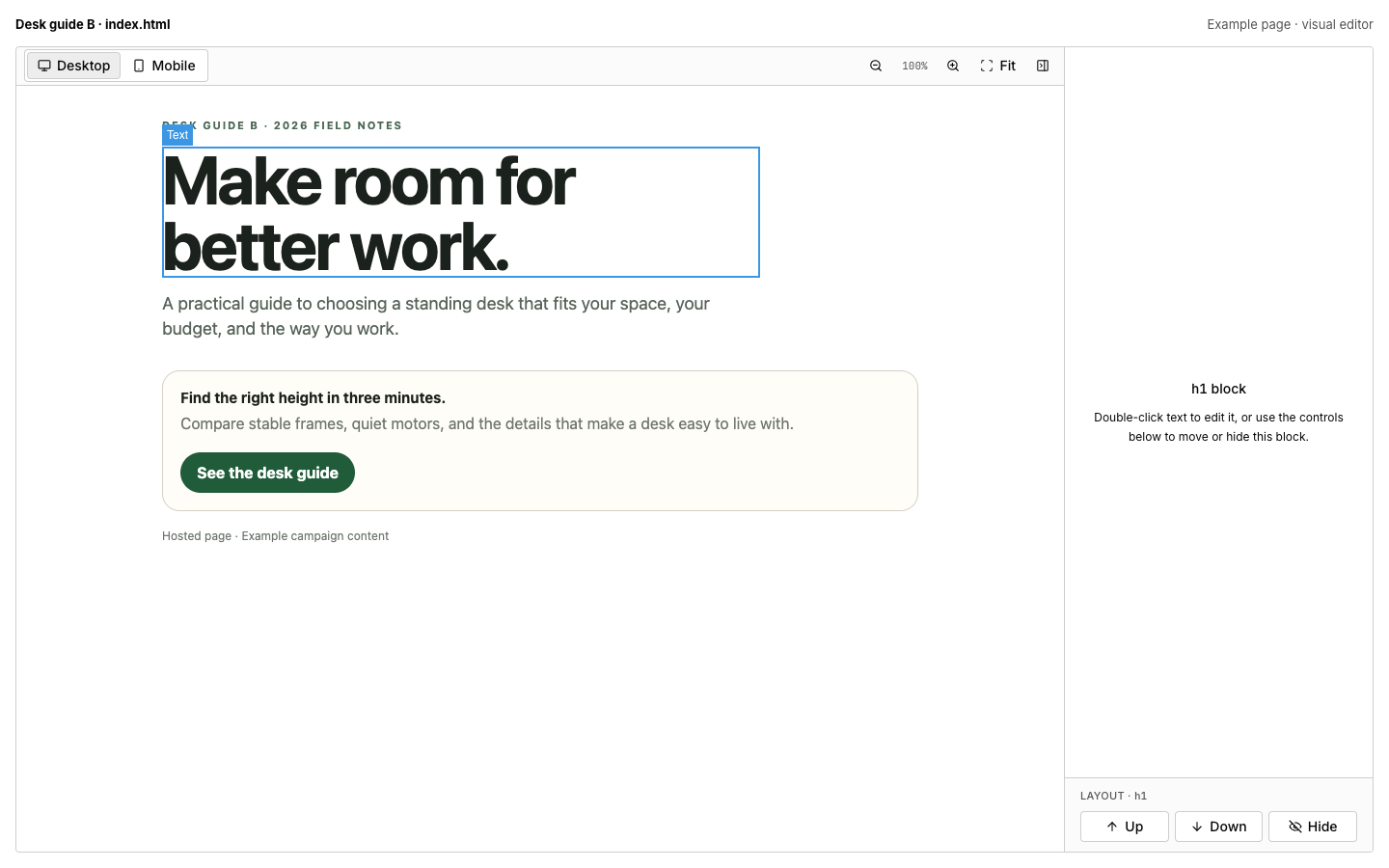
Example editor content; not evidence of campaign performance or conversion uplift.
RedTrack's lander guide describes adding URLs, installing page scripts, and using your page editor. That may suit buyers who already have hosting and publishing they want to keep. The documentation does not establish that RedTrack has no other page-management capability.
A code-grounded campaign example, not a new test
Imagine two imported page variants and one affiliate offer. This is an illustrative walkthrough of current Tracked routing and callback contracts—not executed traffic, measured results, or a customer story.
- Set page A and page B to equal relative weights. The dispatcher selects from the configured pool; it does not discover a winner or guarantee exactly half a small sample.
- Carry the Tracked offer-click reference into the network's supported sub-ID field. A UTM label is not a replacement for that click reference.
- Let an approved sale return an untyped callback shaped like
/postback?click_id=EXAMPLE_CLICK&payout=40¤cy=USD. The ID and $40 are illustrative placeholders, not a working request or observed payout. - Inspect the originating click, attributed conversion, payout, and campaign report. An explicitly typed callback is a secondary funnel signal with zero payout in current code, even if the request supplies a payout.
- Return to the page editor for the next change. Keep the test hypothesis and routing decision under buyer control.
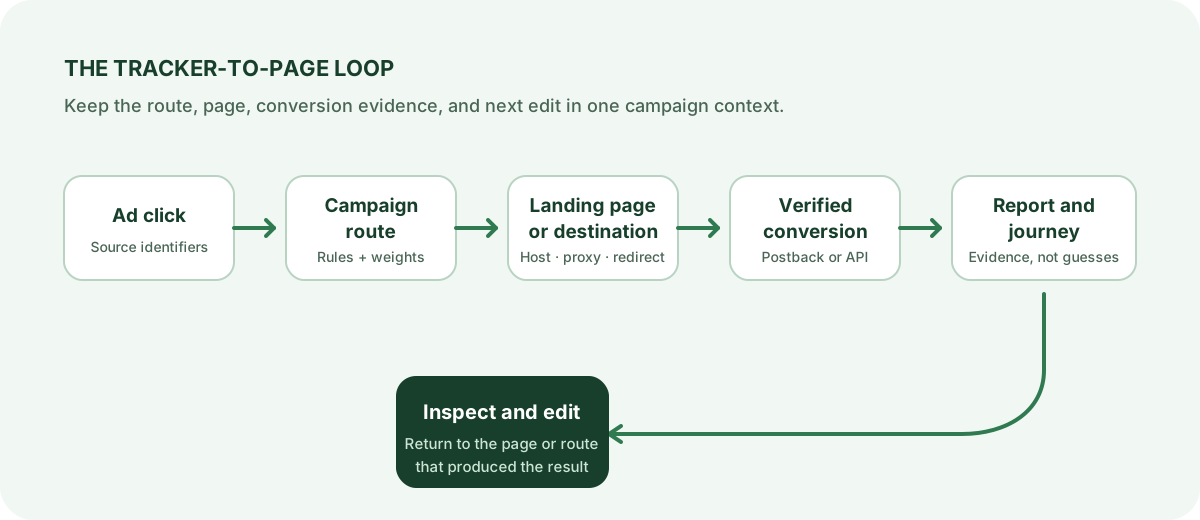
Workflow diagram, not a performance benchmark. Provider delivery is a separate configured step.
A recorded, matched callback provides inbound conversion evidence in the tracker only. It does not prove Meta received or attributed the conversion. Spend mapping and provider response evidence must be inspected separately. For callback setup, see postback URL conversion tracking.
Where Tracked is today
Hosted pages, editing, configured routing, conversion evidence, and reports are supported in current source. Universal CAPI, automatic winner selection, and cross-device attribution remain in development. Same-device anonymous visitor continuity is not cross-device identity matching.
Google Ads delivery requires an eligible account/action mapping, a captured Google click ID, and the applicable consent signal. These are click-conversion uploads, not enhanced conversions. Taboola and NewsBreak require configured click IDs, mappings, and postbacks. Spend sync and outbound support differ by provider; tokens or network logos do not prove native coverage.
Meta can connect a dataset, send a test event, and send an event payload supplied to an authenticated backend route. That is not a finished automatic affiliate-postback-to-Meta workflow. Confirm matching fields, permitted data handling, deduplication, and provider acceptance separately. Read the Meta CAPI boundary before depending on it for ad learning.
RedTrack's pricing advertises native CAPI across several ad platforms and S2S/JSON forwarding elsewhere. Its campaign guide documents separate API and S2S settings. Treat these as documented vendor capabilities; confirm your platform, event type, account access, and subscription rather than assuming integration parity.
Migrate one funnel before moving the account
A working RedTrack funnel has more than a tracking URL. Inventory page paths, scripts, CTA links, offer sub-IDs, conversion types, duplicate modes, currencies, costs, and outbound delivery settings.
Rebuild those mappings deliberately. Old RedTrack click IDs do not become Tracked click IDs. Keep the old callback path available for late conversions during the agreed transition window. Do not assume historical reporting or automation rules transfer unchanged.
Before a cutover, plan evidence checks for the destination, offer click, network callback, spend mapping, and each outbound provider response. Preserve a rollback route and avoid double-delivering the same conversion to an ad platform. These are migration recommendations, not checks executed for this article. Follow the RedTrack-to-Tracked migration checklist.
Frequently asked questions
Is Tracked a direct replacement for every RedTrack integration?
No. Tracked's page-and-report workflow is supported, but provider coverage has explicit limits. If your requirement is automatic Meta affiliate-conversion feedback or another native integration, confirm the complete flow before switching.
Does RedTrack host or edit affiliate landing pages?
The affiliate guide we read adds a page URL and instructs you to change scripts and CTA links in your page editor. That documents an external-page workflow. It is not proof that every RedTrack hosting or editing option is absent.
Are RedTrack's $69 and $141 prices billed monthly?
They are displayed monthly equivalents under annual billing for Builder and Solo. The separately labeled monthly rates are $79 and $169. Check the affiliate section and billed total, not the ecommerce section or discounted headline alone.
Can both products split traffic between pages and offers?
Yes: Tracked supports buyer-configured weights; RedTrack documents weighted funnels. RedTrack also documents smart-distribution setup. Tracked's automatic winner selection remains in development.
Sources and next step
Research checked October 6, 2026: RedTrack pricing, affiliate setup, lander setup, and campaign setup. Tracked statements were checked against the shared plan catalog, public pricing renderer, signup gate, dispatcher routing/callback code, and Meta event routes. Source review is not production verification.
Start free — early access. Use your invite or request access, then bring one page and offer. Confirm current plan terms and required provider feedback before moving production volume.